
Rosalind Morris is Professor of Anthropology at Columbia University, where she has served as director of the Institute for Research on Women and Gender and associate director of the Institute for Comparative Literature and Society. She completed her BA at the University of British Columbia, MA at York University, and PhD at the University of Chicago. Morris has held fellowships at the Institute for Advanced Study, Princeton; Stellenbosch Institute for Advanced Study, in South Africa; Weimar Institute for Cultural Technologies and Media Philosophy; and a Bellagio residency from the Rockefeller Foundation, among others. Her many publications include The Returns of Fetishism: Charles de Brosses and the Afterlives of an Idea (with Daniel Leonard; Chicago, 2017) and Accounts and Drawings from Underground: East Rand Proprietary Mines, 1906 (with William Kentridge; Chicago, 2014), and she is the editor of Can the Subaltern Speak? Reflections on the History of an Idea (Columbia, 2010).
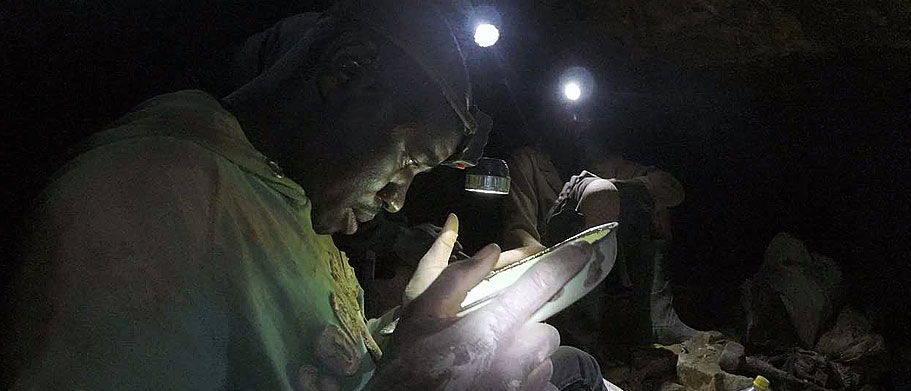
Morris’s Academy project is based on nearly twenty years of field research in South Africa’s gold-mining regions. Drawing on deep ethnography and collaborative filmmaking with undocumented migrants and itinerant miners, Morris analyzes transformations in the social worlds of mining since 1994, when South Africa held its first democratic elections. Local political and global economic forces have accompanied the rise of contract labor and more militant labor organizations—sometimes violently. Unlike most accounts of mining in South Africa, “Unstable Ground” encompasses the lives of individuals and communities beyond those directly involved in mining by including chains of dependency. As Morris explores the “phantasms of miraculous wealth and terrible destruction that suffuse this world,” she also proposes an experiment in ethical thinking. Working with miners she trained to use cameras underground, Morris has produced an archive of “subterranean domains in which strangers greet each other and forge not common languages but polyglot spaces of both contest and mutual recognition.” She argues that this archive can help us forge responses to a broadly acknowledged “migration crisis” that is also causing increased levels of nationalism. In looking at local histories of South Africa in light of global developments, Morris extends insights elaborated in her earlier essays, during documentary filmmaking, and in collaborations with South African artists William Kentridge, Clive van den Berg, Songizile Madikida, and Ebrahim Hajee.

Meet Rosalind Morris
A short portrait filmed at the Hans Arnhold Center, introducing the work and ideas behind fellows’ projects in Berlin.
Upcoming events
Discover what’s coming up in the Academy’s public program this semester.
Past events
Lectures, readings, and conversations from the Academy’s public program.

The Gamblers is an immersive work that aims to take audience members into a world beneath the surface of the earth and across the landscape of postindustrial labor in the ruins of South Africa’s gold mines.

Drawing on two decades of ethnographic fieldwork and using film footage from a documentary on informal mining in the de-industrializing spaces of South Africa’s gold mines, Rosalind Morris considers how the social and material infrastructures of that sector have shaped the forms of life that are emerging in its ruins.
Berlin Journal Articles
Essays, interviews, and creative work published in the Academy’s annual magazine.
Books
Books written by fellows of the Academy, many begun during a semester in Berlin.
Videos
Lectures, readings, and conversations filmed at the Hans Arnhold Center.
Rosalind Morris: The Afterlives of Gold
Rosalind Morris discusses the social and material consequences following the boom of gold mining in Southern Africa.
Fellow Spotlight: Rosalind Morris
Rosalind Morris’s project encompasses nearly twenty years of field research in South Africa’s gold-mining regions.
Explore Past Fellows

Hakim Abderrezak

Marco Abel

David Abraham
