You need the flash plugin and javascript to view this content.
Please download it from here: http://www.adobe.com/shockwave/download/
Published Monday, March 8, 2010 in Past
Economics

Outlook for Financial Regulation

The chair of President Obama's Economic Recovery Board, Paul Volcker, addresses new challenges facing financial regulation and what the United States can do to help prevent future crises in capital markets.

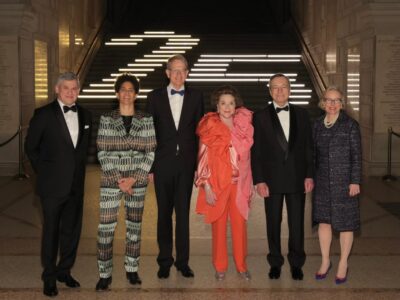
"This challenge is certainly global," says former Federal Reserve Chairman Paul Volcker concerning the future of international financial regulation, "but much depends on our two countries working together to solve the problem." Volcker, now at the helm of President Obama's Economic Recovery Advisory Board, spoke on March 6 at the Federal Presidential residence, Schloss Bellevue, to an audience of distinguished guests -- diplomats, bankers, and fiscal policy legislators -- from across Europe and the United States. The Academy's Spring 2010 Richard von Weizsäcker Distinguished Visitor, Volcker was introduced by German Federal President Horst Köhler and by Peter Y. Solmssen, an Academy Trustee on the management board of Siemens AG, who delivered remarks on the Academy's behalf. Following his talk, Volcker sat down for an in-depth discussion with Jean-Claude Trichet, head of the European Central Bank, Jürgen Fitschen of Deutsche Bank, and Ambassador John Kornblum, a Trustee of the American Academy in Berlin, who moderated. 

Paul Volcker speaking at Schloss Bellevue on March 6, 2010 as the Richard von Weizsäcker Distinguished Visitor of the American Academy in Berlin. Photo: Hans Glave
Published Thursday, March 4, 2010 in Past
Politics

The Rise of India in a Changing World

Sunil Khilnani, the Academy's inaugural Metro Fellow, assesses how India rose from a colonized, class-bound society to become one of the most successful democracies on the planet.

India it is now unquestionably the world's innovation hub, says the New York Times' Thomas Friedman, holding that India is a near-future superpower. The Bush Administration, too, was clear about its wish to help India into superpower status during the twenty-first century; and the Obama Administration seems set to continue to policy, hosting Manmohan Singh, India's Prime Minister, as the first guest of an official State Dinner. Indeed, the numbers point in the same direction: the GDP of the Indian economy, Goldman Sachs analyses detail, will surpass that of the United States before middle of the century. So how did all of this happen -- and so fast? How has India risen from a class-riddled, colonized, overcrowded nation to become one of the rising stars of the global economy? "India's ambitions have been always been immodest," says Sunil Khilnani, the Academy's inaugural Metro Fellow and Director of the South Asia Studies program at the Johns Hopkins University. 

Upcoming
Social Sciences
Tuesday, March 23, 2010, 8:00 pm
Knowing Hearts and Minds: American Social Science and the Quest to Understand and Influence Foreign Publics
Alexander Star
Deputy Editor, New York Times Magazine

Winter 2010 Program

This winter offers a new batch of intriguing lectures and talks at the Hans Arnhold Center: Obama and international law; the many arts of translation; Jeremy Rifkin on the empathic civilization; Albrecht Dürer as collector; India's role in the New World Order; Bonhoeffer in America; and fiction by Amy Waldman and Francisco Goldman. To read about these lectures and more, please download the Winter 2010 Program. We look forward to welcoming you, so please remember to register well in advance of all lectures at program(at)americanacademy.de

All events are free and open to the public unless otherwise noted.

The American Academy in Berlin was established in 1994. Its primary goal is to foster greater understanding and dialogue between the people of the United States and the people of Germany through its presence in Berlin, a city with which the United States should maintain its unique cultural, social, political, and historical links.

The Academy offers residential fellowships at its Hans Arnhold Center to American scholars, writers, policymakers, and artists, permitting them to pursue their work in a manner that encourages participation in the vibrant life of Berlin and Germany. The Academy also brings leading Americans to Berlin for briefer visits to facilitate a robust exchange of views between the people of Germany and the United States.

Support the American Academy

Funding for the American Academy in Berlin is provided almost entirely by private donations from individuals, foundations, and corporations. It is private generosity that has enabled the creation and success of this institution over the past dozen years and what will enable us to sustain the level and excellence of our activities throughout the difficult economic times ahead.

You may make tax-deductible donations to the American Academy from the US or from Germany. Please download the donation form here to make your pledge. The Academy’s account information is:

Berliner Sparkasse
Account no. 660 000 9908
BLZ 100 500 00

For further information or to speak with someone regarding support opportunities, please contact Berit Ebert at +49 030 804 830 x109 or be@americanacademy.de.

Thank you for your support.